road construction - Geosynthetics World
Geosynthetics World

Рубрика: road construction

Geosynthetics in Railway Ballast and Track Maintenance: Drainage, Fouling and Rehabilitation

Geosynthetics in Railway Ballast and Track Maintenance: Drainage, Fouling and Rehabilitation

Railway track is one of the most demanding environments for geosynthetic materials. The repeated dynamic loading from passing trains — thousands of load cycles per day on busy lines — combined with the need to maintain precise track geometry and the progressive degradation of ballast through attrition and fouling create an engineering environment where geosynthetics must deliver reliable performance over decades with minimal maintenance intervention. ...
Read more

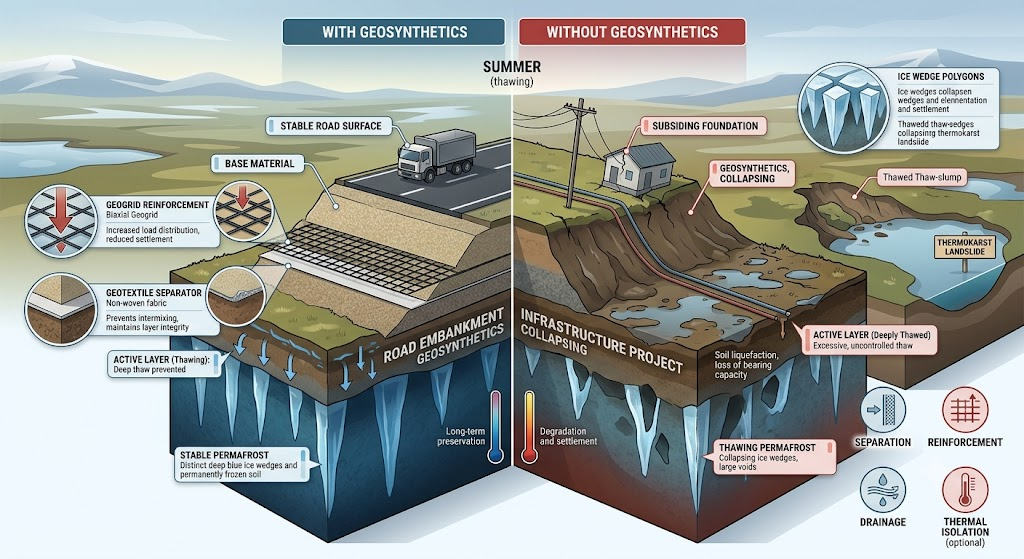
What Is Permafrost and How Do Geosynthetics Help Manage Infrastructure on Frozen Ground?

What Is Permafrost and How Do Geosynthetics Help Manage Infrastructure on Frozen Ground?

Permafrost — ground that remains at or below 0°C for two or more consecutive years — underlies approximately 25% of the Earth's land surface, covering vast areas of Siberia, Canada, Alaska, Scandinavia, the Tibetan Plateau and the high-altitude zones of mountain ranges worldwide. For the communities, industries and infrastructure systems built on permafrost terrain, the frozen ground presents unique and demanding geotechnical challenges. As climate ...

Read more

Road edge drainage-findrain

Road edge drainage-findrain

Water in road construction weakens the substructure and can have disastrous effects on the structure as a whole. Dynamic loads from road traffic generate a pumping effect, drawing water from the subsoil up into the road structure. Varying water table levels undermine the stability of the base course material and can cause cracking right up to the road surface. This is a case for geosynthetic ...

Read more

Green slopes with wire mesh and Enkamat

Green slopes with wire mesh and Enkamat

Enkamat and wiremesh hold soil particals, stones and seeds. The Enkamat functions as a griplayer for hydroseeding. First Enkamat is installed on the slope and then on it wiremesh. As the green of the first hydroseeding does not cover the whole area, a second hydroseeding is needed. Climbing plants have been planted in the toe of the slope. The last picture is taken one year ...

Read more

Reinforcement of roads by geogrids

Reinforcement of roads by geogrids

On weak soils, for road construction contractors generally need a thick layer of base course. Using geogrids as reinforcing layers can help to reduce the required thickness of the unbound base course stabilizing structures on soft ground or in unsettled areas. Another problem is the forces coming from the traffic causes crack on the surface of the road. Geogrid reinforcing layers can absorb the forces ...

Read more

Geogrid with a filter layer

Geogrid with a filter layer

Kocaeli free zone project has a harbour inside the project. There is a heavy traffic of trucks. To prevent or reduce partial settlements on the roads due to the heavy truck traffic special geogrid was used. This multifunctional geogrid delivers reinforcement, separation and filtration in one easy-install product for paved roads, parking areas, platforms and building/structure foundations. In the project it reduced the required subbase ...

Read more

Soil consolidation

Soil consolidation

Civil Engineers, planners and contractors aim for direct economic highways, airports and other traffic routes using natural resources as efficiently as possible in their construction: this often means having to build on poor soils and sometimes even to reclaim land. In many cases, the sub-grade is too weak to allow construction to proceed at a normal rate. Soft, cohesive soils are very slow to consolidate. ...

Read more