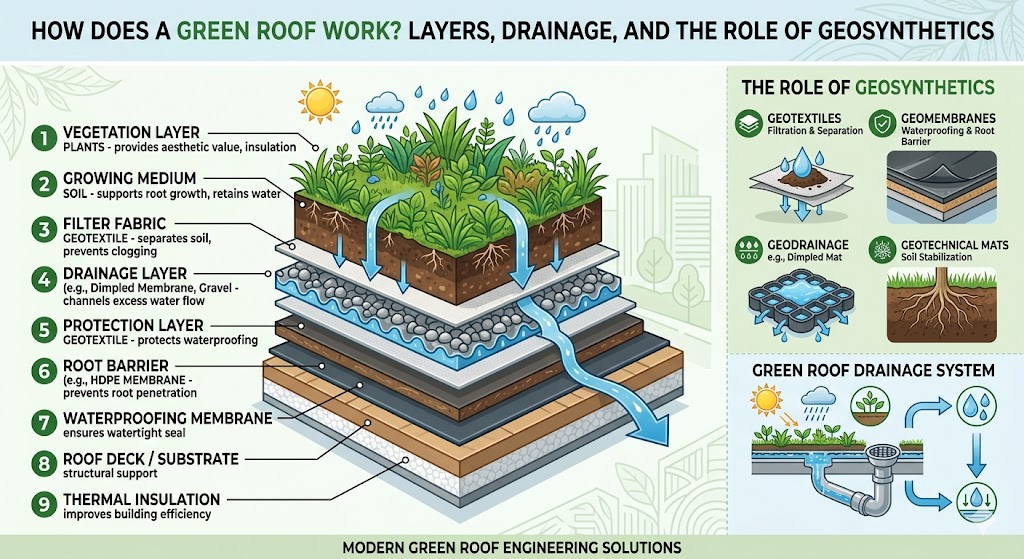
Green roofs — also called living roofs, eco-roofs or vegetated roofs — are roof systems on which plants are cultivated as an integral architectural element. Once regarded as an architectural curiosity, green roofs have become a mainstream tool of sustainable urban design, valued for their contribution to stormwater management, urban heat island mitigation, building energy efficiency, biodiversity support and the psychological wellbeing of building occupants. Yet the engineering that makes a green roof perform reliably over a design life of 40 years or more is far from simple. Every layer in the green roof assembly has a specific and critical function, and geosynthetic materials underpin the performance of several of them. This article explains how green roofs work and what happens — physically and hydrologically — within each layer of the system.
Why Green Roofs Work: The Basic Principle
A conventional roof sheds rainfall almost entirely as surface runoff, delivering a rapid peak flow to the urban drainage system. A green roof intercepts rainfall in its growing medium and drainage layers, retains a proportion of it through evapotranspiration by the plants, delays the remainder through temporary storage, and releases the rest slowly over time. The net effect is a significant reduction in runoff volume and a flattening of the runoff hydrograph — the peak flow is lower and arrives later, easing pressure on urban drainage infrastructure.
Beyond hydrology, the growing medium and plant canopy provide thermal mass and insulation, reducing heat gain through the roof in summer and heat loss in winter. The evapotranspirative cooling effect of the vegetation is a significant contributor to urban heat island mitigation in densely built areas.
Extensive vs Intensive Green Roofs
Green roof systems are broadly classified into two categories based on the depth of the growing medium:
Extensive Green Roofs
Extensive green roofs have a shallow growing medium — typically 50–150 mm deep — planted with drought-tolerant, low-growing species such as sedums, mosses, herbs and grasses. The shallow substrate minimises structural load (typically 60–150 kg/m² saturated) and allows extensive green roofs to be retrofitted onto existing roofs with limited structural capacity. Maintenance requirements are minimal — typically one to two site visits per year once established. Extensive green roofs provide excellent stormwater attenuation and insulation benefits but limited amenity access.
Intensive Green Roofs
Intensive green roofs have a deeper growing medium — typically 200–1000 mm or more — supporting a wider range of plant species including shrubs, perennial plants and even trees. They provide full amenity access and can accommodate complex planting designs, pathways, seating and urban food growing. Structural loads are significantly higher (150–500 kg/m² or more), and maintenance requirements are comparable to a ground-level garden. Intensive green roofs are typically specified on new-build structures designed to accommodate their additional dead load.
The Green Roof Layer System: Function of Each Component
A green roof is a multilayer assembly, each layer performing a specific and non-substitutable function. Reading the cross-section from the structural roof slab upward:
Structural Roof Deck
The structural roof slab — in reinforced concrete, steel or timber — carries the dead load of all green roof layers plus live loads (snow, maintenance, plant loads). The structural engineer must design the roof to accommodate the saturated weight of the full green roof assembly, including a safety factor for ponded water in the event of drain blockage.
Waterproofing Membrane
The waterproofing membrane is the most critical element of the green roof assembly from a building protection perspective. Its function is to prevent any water from penetrating the roof structure. Any failure of the waterproofing membrane results in water ingress to the building below — a failure that is extremely costly and difficult to remediate beneath an established green roof.
Green roof waterproofing membranes must satisfy additional requirements not imposed on conventional roof waterproofing: they must resist root penetration by the plants above, they must withstand decades of exposure to moisture, fertilisers, soil organisms and the mechanical stress of root growth. Materials commonly used include modified bitumen (with polyester reinforcement and copper foil root barriers), EPDM rubber, TPO (thermoplastic polyolefin) and reinforced PVC. Root resistance testing to EN 13948 or FLL standards is mandatory for products specified in green roof applications.
Root Protection Layer
An additional root barrier membrane is sometimes specified above the waterproofing membrane, particularly where the primary membrane does not carry root-resistance certification, or where highly aggressive root species such as bamboo are to be planted. Root barrier membranes are manufactured from HDPE or polypropylene sheet — both materials known to resist penetration by the rooting systems of common green roof species. The root barrier must be installed with sealed laps and carefully detailed at upstands, drains and penetrations.
Protection Layer
A protection layer — typically a nonwoven geotextile, a rubber sheet or a geocomposite drainage product — is placed above the waterproofing membrane to protect it from mechanical damage during the installation of overlying layers and during the operational life of the roof. Drainage aggregate, installation traffic and root growth can all cause damage to the waterproofing membrane if it is not adequately protected. A geotextile protection layer is the most common and economical solution, providing cushioning against point loads and abrasion resistance.
Drainage Layer
The drainage layer is one of the most important engineering components of the green roof system. Its dual function is to remove excess water from the overlying growing medium rapidly — preventing waterlogging of plant roots, which is fatal to most species — while retaining a reservoir of water within its void space for slow release during dry periods, reducing plant water stress between irrigation or rainfall events.
Three principal drainage layer types are used: granular drainage aggregate (expanded clay, lightweight expanded shale, crushed gravel), modular plastic drainage panels with cup-shaped water retention cells, and geocomposite drainage sheets consisting of a three-dimensional polymeric core with integral geotextile filter layers. Geocomposite drainage sheets are the dominant specification in contemporary green roof design, offering a superior combination of hydraulic performance, lightweight, thin profile and reliable factory quality compared with aggregate alternatives.
Filter Layer
A geotextile filter layer is placed between the drainage layer and the overlying growing medium. Its function is to allow water to pass freely downward from the growing medium into the drainage layer, while retaining the fine particles of the growing medium that would otherwise migrate down and clog the drainage layer over time. Without a filter layer, the drainage capacity of the green roof system would progressively decline as fine substrate particles accumulate in the drainage voids. The geotextile must be specified with an Apparent Opening Size matched to the particle size of the growing medium.
Growing Medium (Substrate)
The growing medium is the engineered soil layer in which plant roots develop. Unlike natural garden soil, green roof growing media are specifically formulated to be lightweight, free-draining and resistant to compaction over long periods of wet-dry cycling. They typically consist of a blend of inorganic mineral components — expanded clay, pumice, crushed brick, lava rock — with a small proportion of organic matter. The ratio of inorganic to organic material is higher for extensive systems (typically 80–90% inorganic) to minimise weight and reduce nutrient availability, which encourages drought-tolerant sedum communities.
Vegetation Layer
The plant species selection depends on the green roof type, climate, aspect and the desired ecological, aesthetic and hydrological performance of the system. Sedum species dominate extensive green roofs due to their crassulacean acid metabolism (CAM), which allows them to survive extended drought by closing their stomata during the day and assimilating CO₂ at night. Intensive green roofs support a much wider palette of species, essentially equivalent to a ground-level planting scheme.
Stormwater Performance of Green Roofs
The stormwater retention performance of a green roof depends on the depth and water retention capacity of the growing medium, the capacity of the drainage layer to store and release water, the evapotranspiration rate of the vegetation, and the frequency and intensity of rainfall events. Extensive green roofs in temperate European climates typically retain 40–70% of annual rainfall by volume. Intensive green roofs with deeper substrates can retain 60–90% of annual rainfall.
For regulatory purposes, green roof stormwater attenuation is typically calculated using the rainfall retention model or the flow attenuation model, depending on whether the primary interest is volume reduction or peak flow reduction respectively.
Summary
A green roof is an engineered multilayer system in which every component — from the waterproofing membrane to the plant species — performs a specific, non-substitutable function. Geosynthetic materials contribute critical performance at multiple levels: the waterproofing and root barrier membranes prevent water and root damage to the structure; the protection geotextile shields the waterproofing from mechanical damage; the geocomposite drainage sheet manages water retention and removal; and the filter geotextile maintains long-term drainage capacity by preventing substrate migration. Understanding the function of each layer is the foundation for designing, specifying and maintaining green roof systems that perform reliably throughout their design life.