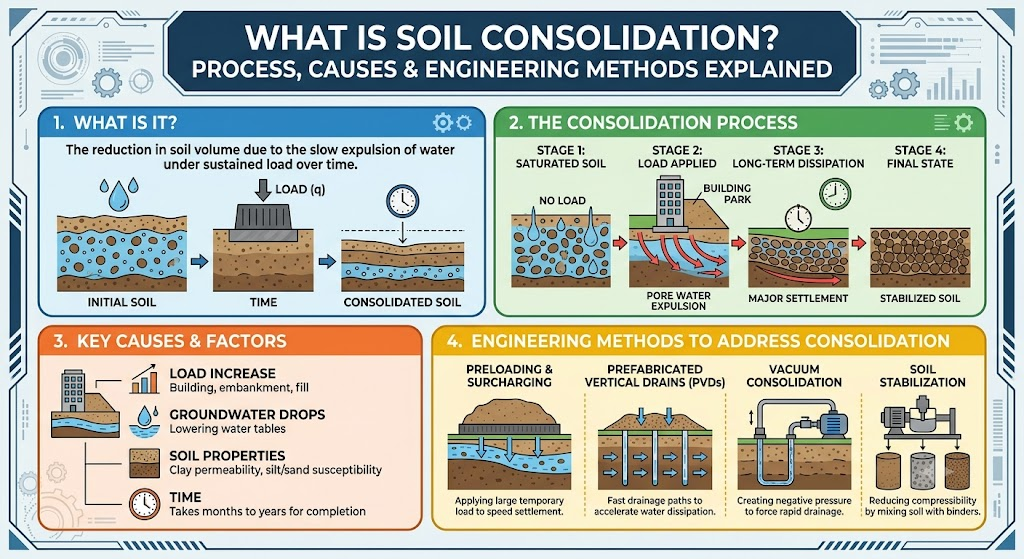
Soil consolidation is one of the most fundamental and practically important concepts in geotechnical engineering. It describes the time-dependent compression of saturated soils under applied load — a process driven by the gradual expulsion of water from the soil’s pore spaces. Understanding consolidation is essential for predicting how much a foundation or embankment will settle over time, how long that settlement will take, and what engineering measures can be used to accelerate the process or reduce its consequences. This article explains what soil consolidation is, how it works, and what methods engineers use to manage it.
Why Soil Consolidates: The Basic Mechanism
All natural soils consist of a framework of solid particles — sand grains, clay minerals, organic matter — with void spaces between the particles. In saturated soils below the water table, these void spaces are completely filled with water. When an external load is applied to a saturated soil — by a building foundation, an embankment, a fill surcharge or any other source — something must carry that load.
The load is initially shared between the pore water and the soil skeleton. Since water is nearly incompressible at civil engineering pressure levels, it initially carries a large proportion of the applied stress. This excess stress in the pore water above the equilibrium hydrostatic pressure is called excess pore water pressure.
Over time, the excess pore water pressure provides a hydraulic gradient that drives water from the high-pressure zone (beneath the applied load) toward drainage boundaries where the pressure is lower. As water escapes from the void spaces, the void ratio decreases — the soil compresses — and the load is progressively transferred from the pore water to the soil particle contacts (effective stress). This transfer of load from pore water to soil skeleton, accompanied by volume decrease and drainage of pore water, is the consolidation process.
Primary and Secondary Consolidation
Primary Consolidation
Primary consolidation is the volume change that occurs as excess pore water pressure dissipates and is transferred to effective stress. It is the dominant consolidation mechanism in most inorganic clays and silts, and it is the component addressed by Terzaghi’s classical consolidation theory. Primary consolidation produces the majority of the total settlement and is time-dependent — its rate is controlled by the hydraulic conductivity and compressibility of the soil.
The magnitude of primary consolidation settlement depends on the compressibility of the soil (characterised by the compression index Cc and the void ratio e₀) and the magnitude of the effective stress increase imposed by the load. The time to complete primary consolidation depends on the soil’s coefficient of consolidation (cv), which combines hydraulic conductivity and compressibility, and on the length of the drainage path.
Secondary Consolidation (Creep)
Secondary consolidation — also called creep — is the additional volume change that occurs after primary consolidation is essentially complete, at effectively constant effective stress. It results from the slow rearrangement and reorientation of soil particles and, particularly in organic soils and peats, from the time-dependent compression of the organic matter itself.
Secondary consolidation can be significant in highly plastic clays, organic clays and peats, where creep rates may be comparable to or exceed primary consolidation settlement. It is characterised by the secondary compression index Cα and continues — at a progressively decreasing rate — essentially indefinitely after primary consolidation is complete.
Terzaghi’s One-Dimensional Consolidation Theory
The mathematical framework for calculating the rate and magnitude of consolidation settlement was developed by Karl Terzaghi in the 1920s and remains the foundation of modern consolidation engineering. Terzaghi’s one-dimensional consolidation theory models the drainage of excess pore water from a saturated clay layer bounded by drainage boundaries above and below (two-way drainage) or above only (one-way drainage).
The theory produces the fundamental relationship that the time required to achieve a given degree of consolidation is proportional to the square of the drainage path length and inversely proportional to the coefficient of consolidation: t = Tv × H²/cv, where Tv is the time factor (a function of the degree of consolidation), H is the drainage path length and cv is the coefficient of consolidation.
This relationship has two critical practical implications. First, thin layers consolidate far faster than thick ones — doubling the layer thickness quadruples the consolidation time. Second, the drainage path can be reduced by introducing artificial drainage elements within the clay layer — the principle behind prefabricated vertical drains.
Factors Governing the Rate of Consolidation
The rate at which a saturated clay layer consolidates depends on several interrelated soil properties:
Hydraulic conductivity (permeability): The ease with which water flows through the soil. Low hydraulic conductivity — typical of soft marine clays at 10⁻⁹ to 10⁻¹⁰ m/s — means water escapes very slowly, prolonging consolidation.
Compressibility (mv): The volume change per unit volume per unit stress increase. Highly compressible soils produce more settlement but may consolidate faster (larger cv) than stiffer soils.
Drainage path length: As noted above, the dominant parameter governing consolidation time. Reducing drainage path length is the most effective means of accelerating consolidation.
Drainage boundary conditions: Whether drainage occurs from one or both faces of the clay layer significantly affects the effective drainage path length and therefore the time to consolidation.
Problems Caused by Soil Consolidation
The consequences of consolidation are most visible as settlement — the downward displacement of the ground surface or foundation as the soil beneath compresses. Settlement problems in civil engineering include:
Differential settlement: Non-uniform settlement across a foundation or structure, causing tilting, cracking or structural damage. Differential settlement is more damaging than uniform settlement because it induces bending and shear stresses in structures.
Long-term settlement: For thick, soft clay deposits, primary consolidation may take decades. Structures built before consolidation is complete will continue to settle throughout their service life.
Embankment instability: Rapid construction of embankments on soft clay generates high excess pore water pressures, reducing shear strength and potentially causing slope failure. This is the classic ’embankment on soft ground’ stability problem.
Infrastructure damage: Roads, pipelines, utilities and buildings on soft clay sites are particularly susceptible to consolidation-induced settlement, which causes surface irregularity, joint distress and service disruption.
Engineering Methods for Controlling Consolidation
Preloading and Surcharge
The simplest method of managing consolidation is to apply the design load in advance of construction — or to apply a temporary surcharge greater than the design load — to cause consolidation to occur before the permanent structure is built. When the surcharge is removed and the structure constructed, the soil has already consolidated and will experience little further settlement. Preloading is effective but time-consuming on thick clay deposits without drainage assistance.
Prefabricated Vertical Drains (PVD)
PVDs — geosynthetic band drains installed at close centres through the soft clay — dramatically reduce the drainage path length, accelerating consolidation by factors of 10 to 100 compared with natural vertical drainage. PVD installation combined with a preloading embankment is the most widely used ground improvement method for soft clay sites globally.
Vacuum Consolidation
Vacuum consolidation involves placing an airtight geomembrane over the preloading area and applying a vacuum beneath it. The vacuum reduces pore water pressure without increasing total stress, driving consolidation without the risk of embankment instability that accompanies conventional surcharging. It is particularly useful on very soft, highly sensitive clays where conventional loading would cause slope failure.
Staged Construction
Rather than applying the full design load immediately, staged construction involves building in increments with waiting periods between stages. During each waiting period, the clay consolidates under the applied load, gaining shear strength. The increased shear strength then allows the next construction stage to be applied safely. Staged construction requires careful monitoring of pore water pressures and settlement throughout the project.
Deep Soil Mixing and Ground Replacement
For more severe soft ground conditions or where time constraints prevent consolidation-based approaches, more invasive ground improvement methods — such as deep soil mixing, stone columns or partial ground replacement — may be used to stiffen the soil mass and reduce settlement directly.
Summary
Soil consolidation is the time-dependent compression of saturated soil caused by the gradual expulsion of pore water under applied loading. Governed by Terzaghi’s consolidation theory, the rate of consolidation depends primarily on hydraulic conductivity and drainage path length. Engineering methods to control consolidation — from preloading with vertical drains to vacuum consolidation — are among the most important tools in the geotechnical engineer’s toolkit for developing soft ground sites. Understanding consolidation mechanics is essential for predicting settlement behaviour and designing safe, economical foundations and embankments on soft soil deposits.