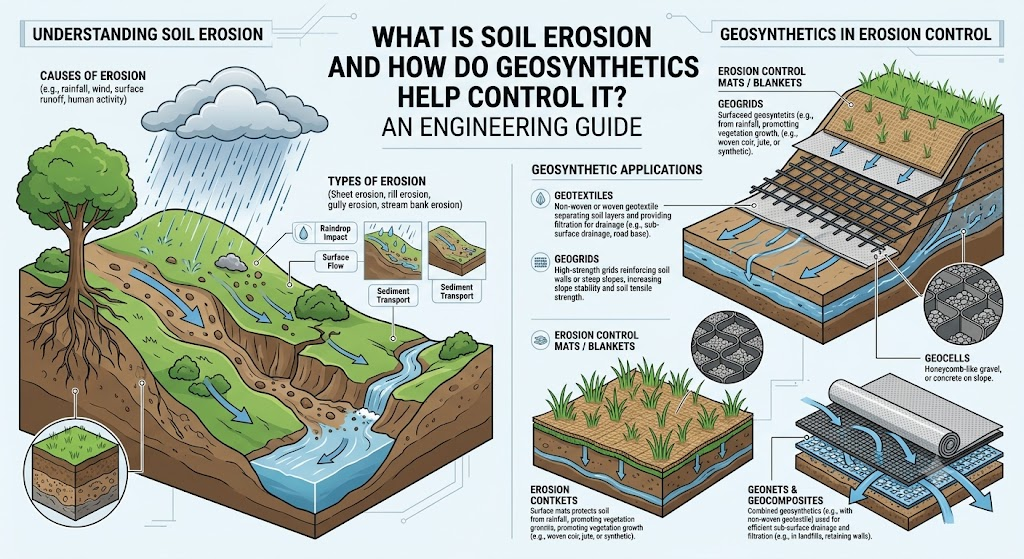
Soil erosion is one of the most pervasive and economically damaging geotechnical hazards on Earth. It affects agricultural land, construction sites, road embankments, riverbanks, coastal cliffs and engineered slopes with equal indifference to their intended purpose. In engineering contexts, uncontrolled soil erosion can undermine infrastructure, cause slope failures, contaminate waterways, and significantly increase the cost of maintaining civil works. Geosynthetic materials offer a powerful, proven and economical toolkit for erosion control — one that has grown increasingly sophisticated over the decades since modern geosynthetic products were first introduced.
What Is Soil Erosion? A Definition
Soil erosion is the process by which soil particles are detached from the land surface and transported by erosive agents — primarily water and wind — to a new location where they are deposited. In the context of civil engineering and geotechnics, water erosion is by far the dominant concern, though wind erosion is significant on exposed, fine-grained surfaces during dry construction phases.
The erosion process has three distinct phases: detachment (soil particles are dislodged from the surface), transport (detached particles are carried away by flowing water), and deposition (particles settle when flow energy decreases). Erosion control strategies can target any or all three phases.
Types of Water Erosion
Raindrop (Splash) Erosion
The impact of individual raindrops on a bare soil surface is a surprisingly powerful erosive force. A single raindrop can reach a terminal velocity of 9 m/s and carries enough kinetic energy to dislodge soil particles up to 60 cm from the impact point. Beyond direct particle detachment, raindrop impact seals the soil surface — creating a thin, compacted crust that dramatically reduces infiltration capacity and increases runoff generation. This makes raindrop erosion the initiating mechanism for many more severe erosion forms.
Sheet Erosion
As rainfall exceeds the infiltration capacity of the soil and begins to flow across the surface, it initially moves as a thin, relatively uniform film — called sheet flow or overland flow. Sheet erosion refers to the shallow, relatively uniform removal of a thin layer of topsoil by this overland flow. It is often unnoticed until it has significantly depleted the topsoil layer, as the soil loss is spatially distributed rather than concentrated.
Rill Erosion
As sheet flow concentrates into small channels — driven by surface micro-topography — flow velocity and hence erosive power increase dramatically. These small channels, called rills, incise into the soil surface and can develop rapidly during a single heavy rainfall event. Rills are typically a few centimetres to tens of centimetres deep and can be repaired by tillage or grading. However, if left unaddressed, rills develop into more serious erosion forms.
Gully Erosion
Gullies are large, deeply incised erosion channels that form when rill erosion progresses beyond the stage where simple grading can remove the feature. Gullies can be metres deep and wide, are highly visible features in the landscape, and represent a significant volume of soil loss. They frequently undercut slopes, destabilise adjacent land and act as sediment sources for downstream waterways. Gully erosion is very difficult and expensive to repair once established; prevention is far more cost-effective.
Channel and Streambank Erosion
The flow of water in rivers, streams, drainage ditches and constructed channels exerts hydraulic shear stress on the bed and bank materials. When this shear stress exceeds the critical shear strength of the bank soil, particles are detached and transported downstream. Streambank erosion causes lateral channel migration, undermines bank-side infrastructure, contributes to downstream sedimentation and can lead to catastrophic bank collapses.
Why Geosynthetics Are Effective for Erosion Control
The fundamental principle behind geosynthetic erosion control is straightforward: protect the soil surface from the direct forces of rainfall impact and flowing water, while establishing or accelerating the development of vegetative cover that will provide long-term, self-sustaining protection.
Geosynthetic erosion control products achieve this through several mechanisms:
Physical armour: Some products provide immediate hard protection against hydraulic shear forces, independent of vegetation.
Seed protection and germination enhancement: Geosynthetic mats retain moisture, moderate temperature extremes and shield seeds from rainfall impact, improving germination rates and establishment success — particularly on steep slopes where topsoil and seed would otherwise wash away before germination.
Root reinforcement: Three-dimensional erosion control mats that remain in place permanently become intertwined with plant roots, creating a composite soil-root-geosynthetic system with far greater resistance to erosion than vegetation alone.
Hydraulic roughness: Erosion control products placed on slope surfaces reduce flow velocities, decreasing the available stream power for soil detachment and transport.
Types of Geosynthetic Erosion Control Products
Erosion Control Blankets (ECBs) and Turf Reinforcement Mats (TRMs)
Erosion Control Blankets are temporary products — typically manufactured from natural fibres (straw, coir, wood) or degradable synthetics — that are placed on slopes and channels to protect the soil surface during the critical vegetation establishment period. They decompose over months to a few years as vegetation establishes, leaving no residue.
Turf Reinforcement Mats are permanent, non-degradable products manufactured from polypropylene or nylon fibres formed into a thick, three-dimensional, open matrix. Soil and seed are placed within the mat, and plant roots grow through and around the mat fibres. The resulting composite system can resist hydraulic shear stresses far exceeding the capacity of vegetation alone — TRMs are rated for channel velocities of 4–6 m/s compared with 1–2 m/s for vegetation without reinforcement.
Three-Dimensional Erosion Control Mats
Three-dimensional synthetic mats — manufactured from entangled polypropylene or nylon monofilaments — provide an open, three-dimensional matrix that is filled with topsoil and seeded with grass or other vegetation. The mat’s three-dimensional structure mechanically reinforces the root zone, and its presence modifies near-surface hydraulics to reduce erosive flow velocities. These products are particularly effective on moderately steep slopes (1V:2H to 1V:1H) in temperate climates where rapid grass establishment is achievable.
Cellular Confinement Systems (Geocells) for Erosion Control
On steeper slopes, in channels with higher flow velocities, or where vegetation establishment is uncertain, geocell systems infilled with angular gravel or concrete provide a hard armour solution that does not rely on vegetation. The cell walls confine the infill material, preventing its lateral displacement by hydraulic forces, while the permeable base allows drainage and reduces uplift pressures.
Geotextile Filters in Erosion Control Works
Geotextile filter layers are a critical component of most hard erosion control systems — placed beneath rock armour, gabion mattresses, concrete revetment or geocell systems to prevent the fine-grained soil base from being washed out through the voids of the armour layer (a process called ‘piping’ or ‘suffusion’). Without adequate filtration, even the most robust armour layer will fail as the underlying soil progressively migrates away.
Selecting the Right Erosion Control Solution
The appropriate geosynthetic erosion control product depends on several site-specific factors:
Slope gradient and length: Steeper and longer slopes generate higher surface flow velocities and greater erosive forces, requiring more robust products.
Soil erodibility: Fine-grained, poorly graded soils with low cohesion are most susceptible to erosion. Highly erodible soils require immediate, high-performance protection.
Climate and rainfall intensity: High-intensity rainfall events are most erosive. Products must be designed to resist the peak rainfall intensity expected during the vegetation establishment period.
Vegetation establishment potential: Where reliable vegetation establishment is expected, temporary or semi-permanent products may suffice. Where conditions are marginal for vegetation, permanent TRMs or hard armour systems are appropriate.
Design velocity (for channels): The maximum flow velocity expected in the channel or at the slope toe determines whether temporary ECBs, permanent TRMs, or hard armour is required.
Summary
Soil erosion is a complex, multi-phase process that threatens the integrity of engineered slopes, channels, embankments and riverbanks. Geosynthetic erosion control products — from temporary straw blankets to permanent three-dimensional turf reinforcement mats and geocell systems — provide engineering solutions scaled to the severity of the erosion hazard. By protecting the soil surface during the vulnerable vegetation establishment period and providing long-term root reinforcement, these products deliver reliable, cost-effective erosion control across the full spectrum of civil engineering applications.