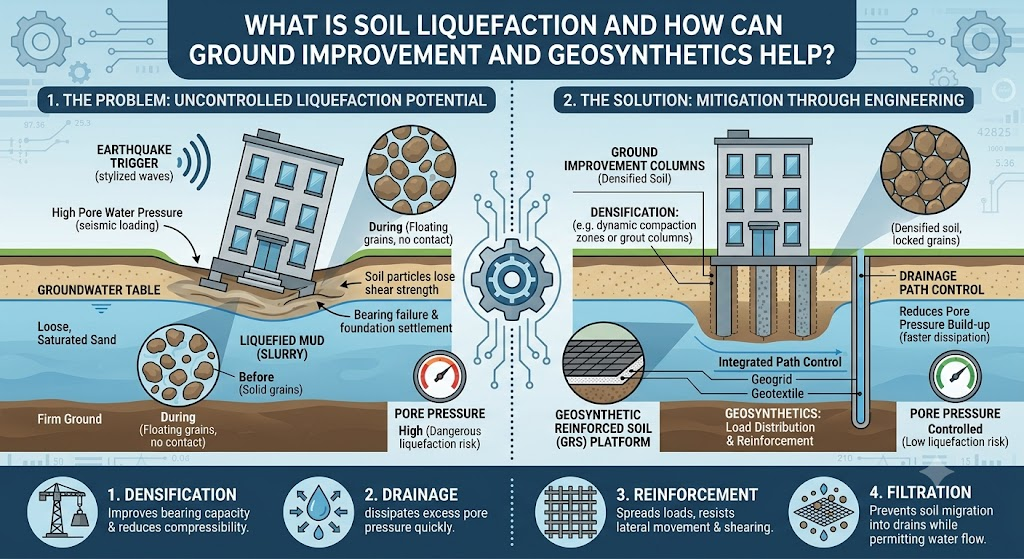
Soil liquefaction is one of the most dramatic and destructive geotechnical phenomena associated with earthquake shaking. During a significant seismic event, loose, saturated sandy soils can rapidly lose their strength and stiffness, behaving temporarily like a dense liquid rather than a solid. Buildings tilt and sink, ground surfaces heave and crack, buried structures float upward, and roads and bridges collapse — all as a direct consequence of the ground beneath them losing its ability to support load. Understanding what liquefaction is, what conditions favour it, and how engineers assess and mitigate the risk is essential knowledge in seismically active regions worldwide. Geosynthetics play supporting but important roles in several of the most effective liquefaction mitigation strategies.
What Is Liquefaction? The Physical Mechanism
Liquefaction occurs in saturated, loose granular soils — primarily fine to medium sands and non-plastic silts — when earthquake shaking generates rapid, cyclic stress reversals in the soil skeleton. Under normal conditions, the weight of overlying soil is carried by the contact forces between soil particles — the effective stress. The pore water fills the voids between particles but does not carry the structural load.
When earthquake shaking applies rapid cyclic shear stresses to a loose saturated sand, the soil skeleton tends to contract — the loose packing of particles rearranges toward a denser configuration. In a drained condition, this contraction would cause settlement and densification. But earthquake shaking is so rapid that there is insufficient time for pore water to drain: the tendency for volume decrease is instead accommodated by an increase in pore water pressure. As the excess pore water pressure builds up with each stress cycle, the effective stress progressively decreases. When the excess pore water pressure equals the total overburden stress, the effective stress reaches zero — the soil particles are no longer in contact with each other, supported instead by the pressurised pore water — and the soil behaves as a viscous liquid with essentially zero shear strength. This state is full liquefaction.
Once liquefied, the soil loses its ability to support structures, slopes or its own weight on inclined surfaces. Structures sink or tilt, lateral spreading of gently sloping ground causes displacement of hundreds to thousands of millimetres, and sand boils — fountains of liquefied sand and water — erupt through cracks in the overlying ground crust. Recovery of strength occurs as the excess pore water pressure dissipates after shaking ceases, but the damage caused during the liquefied state is often permanent and severe.
Which Soils Are Susceptible to Liquefaction?
Not all soils can liquefy. Liquefaction susceptibility depends on several interconnected soil characteristics:
Grain size: Loose, uniformly graded fine to medium sands (particle size 0.075–2 mm) are most susceptible. Gravels drain too rapidly for pore pressures to build up; clays have too high a cohesion to lose strength in the same mechanism, though sensitive clays can experience analogous strength loss.
Relative density: Loose sands (low relative density, Dr < 50%) are far more susceptible than medium-dense or dense sands. Dense sands tend to dilate under shear loading rather than contract, generating negative pore pressures that increase strength rather than reducing it.
Saturation: The soil must be fully or nearly fully saturated — above the water table — for liquefaction to occur. Partially saturated soils have compressible air in their pores that absorbs some of the tendency for volume change without generating high pore pressures.
Drainage conditions: Poorly drained conditions — either because the soil has low permeability or because the drainage path is long — favour pore pressure buildup. Gravelly or well-drained soils dissipate pore pressures rapidly and are far less susceptible.
Age and origin: Recently deposited, young alluvial and aeolian sands (Holocene age) are most susceptible. Older, overconsolidated deposits and cemented sands are generally more resistant.
Assessing Liquefaction Risk
Engineers assess liquefaction susceptibility by comparing the seismic demand on the soil — expressed as the Cyclic Stress Ratio (CSR), a function of the earthquake peak ground acceleration and the vertical effective stress — with the soil’s capacity to resist liquefaction — expressed as the Cyclic Resistance Ratio (CRR), derived from in-situ test data. The factor of safety against liquefaction is FS = CRR / CSR; values below 1.0 indicate liquefaction is expected during the design earthquake.
The most widely used methods for determining CRR rely on Standard Penetration Test (SPT) blow counts or Cone Penetration Test (CPT) tip resistance — both of which reflect the in-situ density and fabric of the soil. Empirical correlations between these measurements and field liquefaction performance data from historical earthquakes form the basis of the Seed-Idriss simplified procedure and its subsequent refinements, which remain the standard of practice for liquefaction assessment worldwide.
Liquefaction Mitigation Methods
Densification
The most direct approach to liquefaction mitigation is densification — increasing the relative density of the liquefiable soil to a level at which it becomes resistant to pore pressure buildup under the design earthquake loading. Vibro-compaction (vibratory probe densification of clean sands), dynamic compaction (heavy tamper dropping), and explosive compaction are all effective densification techniques for loose sands.
Geosynthetics play a limited direct role in densification itself but are used in the post-treatment working platform and separation layers within the improved ground zone.
Drainage to Prevent Pore Pressure Buildup
If excess pore water pressure can be dissipated during earthquake shaking — faster than it is generated by the cyclic loading — liquefaction will not occur. Gravel drains and prefabricated vertical drains (PVDs) installed at close spacing through a liquefiable deposit provide preferential drainage paths that allow rapid dissipation of earthquake-induced pore pressures. PVDs used in liquefaction mitigation must be specified with higher discharge capacity than standard consolidation drains, since the required flow rates during earthquake-induced pore pressure dissipation are much higher than in the slow consolidation drainage application.
The geotextile filter jacket of the PVD is equally critical in liquefaction drainage applications: the filter must retain soil particles from the potentially mobile liquefied sand while maintaining the high discharge capacity required for rapid pressure relief.
Geosynthetic-Encased Stone Columns
Stone columns installed through liquefiable deposits provide both densification of the surrounding sand (during installation) and drainage (during earthquake shaking). However, in very loose, fine-grained sands, conventional unencased stone columns may themselves liquefy or lose lateral confinement during shaking. Geosynthetic-encased stone columns — in which each column is wrapped in a geotextile or geogrid sleeve before aggregate installation — maintain column integrity during liquefaction of the surrounding soil, preserving both the drainage function and the vertical load-carrying capacity of the column throughout and after the earthquake.
Reinforcement Against Lateral Spreading
Where liquefaction is judged acceptable — for example, in areas of low seismicity or where the consequence of some ground movement is tolerable — geosynthetic reinforcement layers can be used to limit the damage caused by lateral spreading of liquefied ground. High-tensile geogrid or woven geotextile reinforcement layers at the base of embankments or beneath structures provide tensile resistance to the lateral displacement that would otherwise occur if the underlying soil liquefied. This approach does not prevent liquefaction but reduces its structural consequences.
Cementation and Permeation Grouting
Chemical grouting, cement grouting and microbially induced calcite precipitation (MICP) can increase the strength and stiffness of liquefiable sands by filling pore spaces with cementing agents. These techniques are most applicable in urban environments where vibration-based densification is impractical. Geosynthetics play no direct role in grouting-based mitigation.
Consequences of Liquefaction: Historical Case Studies
The 1964 Niigata earthquake in Japan produced widespread liquefaction of the loose alluvial deposits underlying the city, causing apartment buildings to tilt dramatically and sink into the ground, and severely damaging harbour infrastructure. The 1964 Alaska earthquake triggered the largest earthquake-induced landslide in recorded history in Turnagain Heights, Anchorage, driven by liquefaction of sensitive marine clay layers. The 2010–2011 Canterbury earthquake sequence in New Zealand produced extensive liquefaction across Christchurch, causing billions of dollars of damage to residential and commercial buildings and infrastructure and leading to the abandonment of entire suburbs. These events drove major advances in liquefaction research and engineering practice.
Summary
Soil liquefaction occurs when loose, saturated sands lose their shear strength under earthquake cyclic loading as pore water pressure builds up to eliminate effective stress. Susceptibility depends on soil gradation, relative density, saturation and drainage conditions. Engineers assess risk using CSR versus CRR comparisons derived from SPT or CPT data. Mitigation strategies include densification, drainage enhancement using PVDs and gravel drains, geosynthetic-encased stone columns that maintain drainage and load capacity during shaking, and geosynthetic reinforcement layers that limit lateral spreading. Understanding liquefaction mechanics and the range of available mitigation tools is essential for geotechnical engineers working in seismically active regions worldwide.