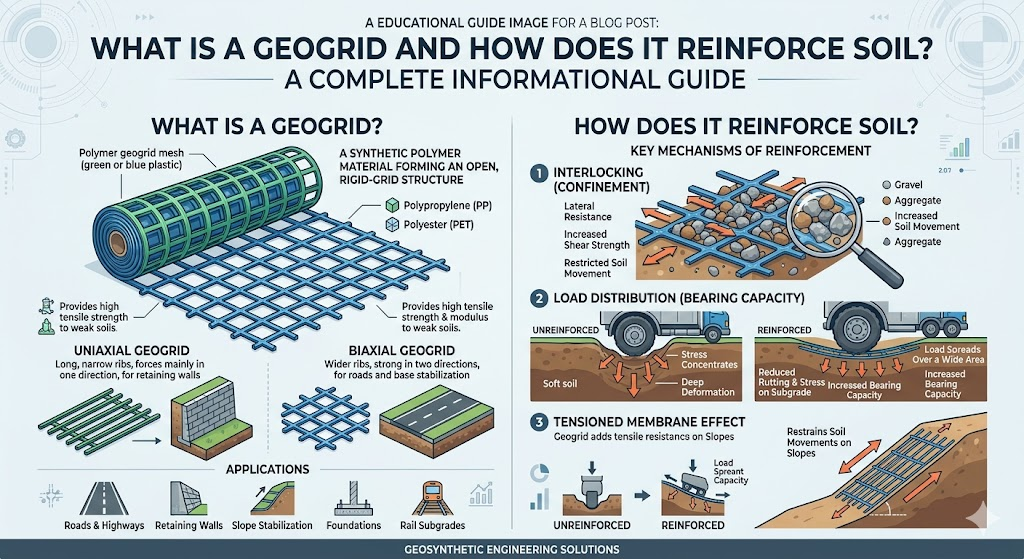
Among the family of geosynthetic materials used in civil and geotechnical engineering, geogrids occupy a unique and important position. Unlike geotextiles — which are solid fabrics — geogrids are open-mesh structures with large apertures through which soil and aggregate particles can penetrate and interlock. This interlock mechanism is the source of their remarkable ability to reinforce soils and granular materials, improving bearing capacity, reducing rutting and enabling the construction of steeper slopes and taller retaining structures than would otherwise be possible. This guide explains what geogrids are, how they work, what types exist and where they are used.
Defining a Geogrid
A geogrid is a geosynthetic material consisting of a regular open network of tensile elements — called ribs — connected at their junctions to form a grid-like structure. The apertures between the ribs are large enough — typically 10 mm to 100 mm — to allow soil or aggregate particles to penetrate through the plane of the grid and interlock with the rib structure. This distinguishes geogrids from geotextiles, which are solid fabrics through which particles cannot pass.
Geogrids are manufactured primarily from high-density polyethylene (HDPE), polypropylene (PP) or polyester (PET), depending on the performance requirements of the application. They are produced in rolls and installed horizontally within soil or aggregate layers, or as face elements in reinforced slope and retaining wall systems.
The defining engineering property of a geogrid is its tensile stiffness — the resistance to elongation under load — expressed as the tensile load per unit width at a defined strain level (kN/m at 2% or 5% strain). High stiffness at low strain is particularly valuable in road base reinforcement, where limiting deformation under traffic loading is the primary design objective.
How Does a Geogrid Work? The Interlocking Mechanism
The reinforcement effect of a geogrid arises from three interrelated mechanisms: confinement, interlocking and tensioned membrane effect. Understanding each mechanism is important for appreciating why geogrids are so effective in granular material reinforcement.
Lateral Confinement
When a granular material such as road base aggregate or compacted gravel is placed on a geogrid and loaded vertically — by vehicle tyres, for example — it tends to spread laterally. A geogrid layer within the aggregate resists this lateral spreading by mobilising tensile force in its ribs. This confinement effect increases the apparent cohesion of the aggregate layer and improves its load-spreading capability over the underlying subgrade.
Interlocking
Aggregate particles that penetrate through the apertures of the geogrid and bear against the lateral faces of the ribs are mechanically locked to the grid. This interlocking creates a composite layer — sometimes referred to as a ‘mechanically stabilised layer’ — in which the aggregate and the geogrid act together as a single structural unit. The efficiency of interlocking depends on the relationship between aperture size and aggregate particle size; optimal interlock occurs when the aggregate D50 is approximately 50–100% of the aperture dimension.
Tensioned Membrane Effect
When a geogrid is placed over a soft subgrade and deflects under load, the tensioned geogrid membrane provides an upward reaction force that partially supports the applied load, reducing the stress on the subgrade. This effect is most significant on very soft subgrades where large deformations occur, and it is an additional benefit rather than the primary design mechanism in most road base reinforcement applications.
Types of Geogrid
Uniaxial Geogrids
Uniaxial geogrids are manufactured with high tensile strength in one principal direction only — the machine direction. They are produced by punching a regular pattern of holes in a polymer sheet and then drawing the sheet longitudinally, which orients and aligns the polymer molecules in the draw direction, dramatically increasing tensile strength and stiffness in that direction.
The high tensile strength in a single direction makes uniaxial geogrids ideal for applications where load acts predominantly in one direction — most notably in reinforced soil retaining walls and steep slopes, where horizontal tensile reinforcement resists the tendency of the retained soil mass to slide or overturn. Typical tensile strengths range from 30 kN/m to over 200 kN/m at 2% strain.
Biaxial Geogrids
Biaxial geogrids are drawn in both the machine and transverse directions after punching, producing a product with significant tensile stiffness in both principal directions. This bidirectional stiffness makes biaxial geogrids ideal for applications where loads are applied in multiple directions — such as road base reinforcement, where vehicle tyres apply loads from various angles, and platform stabilisation.
The square or rectangular aperture geometry of biaxial geogrids promotes efficient interlocking with aggregate in all directions, making them the standard specification for granular layer reinforcement in pavement and working platform design.
Triaxial Geogrids
Triaxial geogrids are punched and drawn at multiple angles, producing a product with ribs oriented at 0°, 60° and 120° to the machine direction. This triangular rib geometry results in a stiffer, more isotropic structure than biaxial geogrids, with improved resistance to in-plane rotation of the apertures under load. Research has demonstrated that triaxial geogrids can provide superior confinement of aggregate compared with biaxial products at equivalent rib weights, due to the more stable triangular geometry.
Welded and Woven Geogrids
An alternative manufacturing route produces geogrids by weaving or knitting high-tenacity polyester yarns into a grid structure, then coating the product with a polymer jacket to protect the fibres and stabilise the junctions. These products offer very high tensile strength at relatively low weights and are particularly suited to high-load reinforcement applications such as basal reinforcement of embankments over soft ground and bridge approach fills.
Key Engineering Properties of Geogrids
Selecting a geogrid requires evaluation of several interdependent properties:
Tensile strength and stiffness (kN/m): The most important mechanical property, measured at specified strain levels (2%, 5% and ultimate). The design strain is typically limited to 2–3% to ensure acceptable deformation of the reinforced structure.
Junction strength: The load capacity of the junction between intersecting ribs governs the ability of the geogrid to transfer stress through the grid network. Low junction efficiency reduces the effective reinforcement modulus of the product.
Aperture size and shape: Determines interlocking efficiency with the adjacent aggregate. Aperture dimensions must be matched to the particle size of the material being reinforced.
Creep resistance: Under sustained load, polymer materials elongate progressively over time — a phenomenon called creep. The design tensile strength of a geogrid is typically reduced by a ‘creep reduction factor’ to account for this long-term behaviour. HDPE and PP products require careful creep consideration; PET products generally exhibit lower creep rates.
Durability: Geogrids must resist the chemical environment of the soil (pH, leachate chemistry), installation damage from compaction plant, and biological degradation throughout their design life — typically 50–120 years for permanent structures.
Applications of Geogrids in Civil Engineering
Road Base and Pavement Reinforcement
Biaxial and triaxial geogrids placed within or at the base of the granular sub-base or base course of a road pavement improve load distribution and reduce rutting under traffic. Design methods based on traffic loading, subgrade CBR and required service life can quantify the reduction in aggregate thickness achievable with geogrid inclusion — typically 20–40% compared with an unreinforced equivalent.
Reinforced Soil Retaining Walls
Uniaxial geogrids are the primary reinforcing element in mechanically stabilised earth (MSE) retaining walls. Multiple layers of geogrid are placed horizontally within the compacted fill behind the wall face at vertical spacings of 0.3–0.6 metres. The geogrid layers resist the horizontal earth pressure that would otherwise require a massive gravity wall or heavily reinforced concrete structure. MSE walls with geogrid reinforcement can be constructed to heights exceeding 10 metres and are routinely used in highway, bridge abutment and railway embankment construction.
Steep Slope Reinforcement
Slopes steeper than the natural angle of repose of the fill material can be constructed using geogrid reinforcement layers within the fill mass. Geogrid-reinforced slopes at angles of 50°–70° from horizontal are technically feasible and are used in space-constrained construction situations such as motorway widening, coastal erosion management and mining operations.
Embankment Basal Reinforcement Over Soft Ground
High-tensile woven or welded polyester geogrids placed at the base of embankments over soft clay subgrades provide tensile resistance to lateral spreading and rotational failure of the embankment. This allows embankments to be constructed more rapidly and to greater heights than would be possible without reinforcement, while controlling differential settlement.
Geogrid vs Geotextile: Key Differences
The most common point of confusion in geosynthetics specification is the distinction between geogrids and geotextiles. The fundamental differences are:
Apertures: Geogrids have large open apertures that allow aggregate interlock. Geotextiles are solid fabrics with microscopic pore openings.
Primary function: Geogrids primarily reinforce. Geotextiles primarily separate, filter and drain.
Tensile stiffness: Geogrids are designed with high stiffness at low strain for structural reinforcement. Geotextile reinforcement products exist but are less stiff at equivalent weights.
Drainage: Geogrids provide no meaningful filtration or drainage. Geotextiles manage water movement through and along their plane.
In practice, geogrids and geotextiles are often used together — a geotextile separation layer beneath a geogrid reinforcement layer is a common combined system in road base and working platform design.
Summary
Geogrids are precision-engineered tensile reinforcing elements that derive their effectiveness from the mechanical interlocking of aggregate particles within their apertures. Available in uniaxial, biaxial and triaxial forms to match specific loading directions and application requirements, geogrids improve bearing capacity, reduce deformation and enable construction of steeper slopes and taller retaining structures. Understanding the interlocking mechanism, the key performance parameters and the distinction between geogrid types is essential for engineers seeking to specify these materials correctly in road, retaining wall, slope and foundation applications.