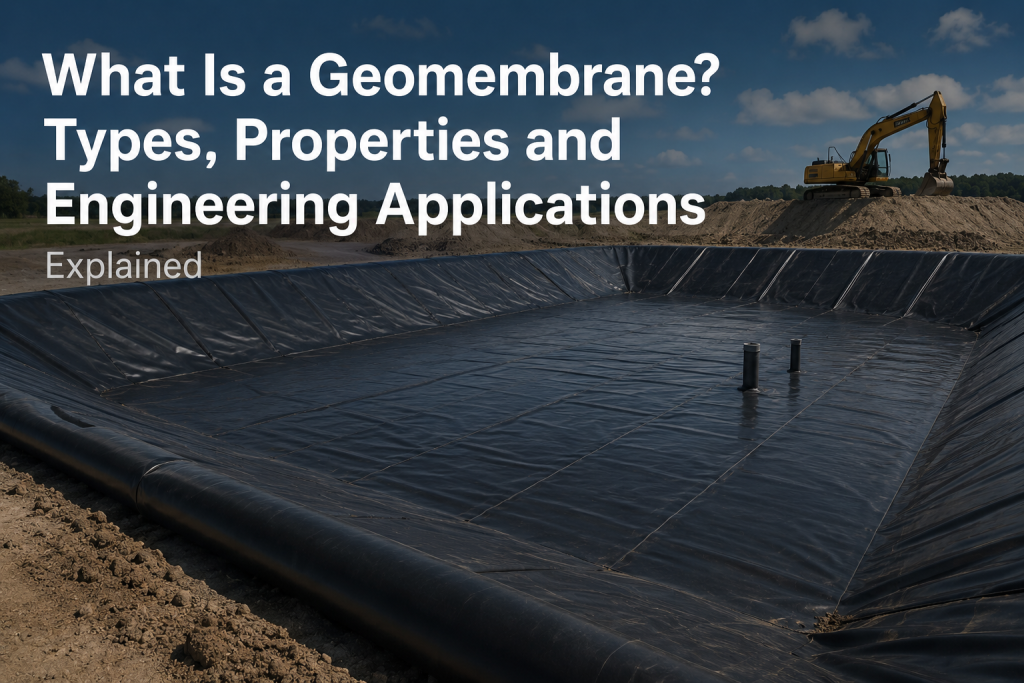
Among all geosynthetic materials used in civil and environmental engineering, the geomembrane is arguably the most critical in high-stakes containment applications. It forms the primary hydraulic barrier in landfill liner systems, the impermeable lining in water storage reservoirs, the waterproofing layer beneath green roofs, and the environmental protection barrier in mining operations. This article explains what a geomembrane is, how it differs from other geosynthetics, what types are available and how each performs in practice.
Defining a Geomembrane
A geomembrane is a continuous, flexible, impermeable sheet manufactured from synthetic polymer materials. Its fundamental purpose is to act as a hydraulic barrier — preventing or severely restricting the movement of liquid or gas through or across its plane. Unlike geotextiles, which are designed to be permeable and allow water to pass through, geomembranes are specifically engineered for impermeability.
The practical hydraulic conductivity of an intact geomembrane is extraordinarily low — values in the range of 1×10⁻¹² to 1×10⁻¹⁵ m/s are commonly cited, orders of magnitude lower than even well-compacted natural clays. In practice, the limiting factor in any geomembrane liner system is not the membrane itself but rather the integrity of its seams and the quality of its installation.
Geomembranes are manufactured in factories and delivered to site in rolls. Panels are deployed, overlapped and joined by thermal welding or adhesive bonding to create a continuous, seamless liner system covering the entire required area.
Principal Geomembrane Types
HDPE — High-Density Polyethylene
HDPE is the most widely specified geomembrane material globally, accounting for the majority of installations by area. It is produced from high-density polyethylene resin with a density of approximately 0.935–0.965 g/cm³ and contains around 97.5% polyethylene with 2–3% carbon black (for UV stabilisation) and antioxidants.
HDPE offers outstanding chemical resistance, excellent long-term UV stability in exposed conditions, and very high tensile strength. Its stiffness — which is higher than other polyethylene types — makes it well-suited to flat installations with good subgrade support. However, HDPE has relatively low elongation at break compared with LLDPE, meaning it is less forgiving on irregular or settling subgrades. Typical installation thicknesses range from 1.0 mm for secondary containment to 2.5 mm for primary landfill bottom liners.
LLDPE — Linear Low-Density Polyethylene
LLDPE geomembranes are manufactured from linear low-density polyethylene resin, producing a more flexible product than HDPE with significantly higher elongation at break — typically 700–900% compared with 600–700% for HDPE. This superior flexibility makes LLDPE an excellent choice for applications where the liner must conform to complex geometries, irregular subgrades, or where some post-installation settlement is anticipated.
LLDPE is commonly specified for decorative ponds, irrigation reservoirs, smaller containment applications and side slopes in landfill systems where the liner must drape smoothly over a compacted clay surface. It offers similar chemical resistance to HDPE but slightly lower tensile strength at equivalent thicknesses.
PVC — Polyvinyl Chloride
PVC geomembranes have been used since the 1950s, making them one of the earliest geomembrane materials. Unreinforced PVC is very flexible and easy to handle, making it popular for smaller water containment applications and temporary works. However, PVC contains plasticisers which can migrate from the membrane over time, causing it to become brittle and reducing its long-term performance. This plasticiser migration also raises environmental compatibility concerns in sensitive containment applications.
Reinforced PVC, incorporating a polyester fabric scrim, overcomes many of the dimensional stability limitations of unreinforced PVC and provides a product suitable for larger, permanent water containment applications. It is widely used in irrigation ponds, fish farming and decorative water features.
EPDM — Ethylene Propylene Diene Monomer
EPDM geomembranes are thermoset rubber products offering exceptional flexibility and elongation — typically over 300% — and outstanding resistance to ozone, UV radiation and weathering. They are widely used in roofing membranes, decorative garden ponds and water features where long-term flexibility and weather resistance are paramount. EPDM is not thermally weldable and requires adhesive or tape jointing, which requires careful quality control.
EVOH and Other Specialty Membranes
Ethylene vinyl alcohol (EVOH) barrier films are used in multi-layer geomembrane systems where resistance to specific chemical permeation is required. Other specialty products include reinforced polypropylene (RPP), thermoplastic polyolefin (TPO) and various fluoropolymer-based membranes for highly aggressive chemical environments.
How Geomembrane Seams Are Made
The integrity of a geomembrane installation depends as much on its seams as on the membrane itself. Poor seam quality is the primary cause of geomembrane liner failure. Two principal welding methods are used:
Hot Wedge (Thermal Fusion) Welding
A heated metal wedge is drawn between two overlapping panels, melting the upper surface of the lower sheet and the lower surface of the upper sheet simultaneously. The two molten surfaces are then pressed together by guide rollers, fusing into a single continuous weld. Hot wedge welding produces a double-track seam with an unwelded channel between the two tracks, which can be pressurised with air for non-destructive seam testing. This method is the most widely used for HDPE and LLDPE seaming.
Extrusion (Fillet) Welding
A ribbon of molten polyethylene extrudate is deposited over the overlapping panel edges while the base material is simultaneously pre-heated by a hot air gun. The extrudate bonds to both panels, creating a fillet weld. Extrusion welding is used primarily for patch repairs, detailed areas such as corners and penetrations, and locations inaccessible to the hot wedge machine.
Testing and Quality Assurance of Geomembrane Seams
All geomembrane installations require a rigorous quality assurance programme. Non-destructive testing of seams includes:
Air pressure testing: The double-track channel of hot wedge seams is inflated to a specified pressure and monitored for pressure drop over a defined period.
Vacuum box testing: A transparent box with a rubber gasket seal is placed over the seam, the area is wetted with soapy water, and a vacuum is applied. Any defects appear as soap bubbles drawn through the leak point.
Spark (holiday) testing: An electric probe traverses the seam; any breach in the membrane creates a spark, indicating a defect location.
Destructive testing: Sample coupons cut from the seam are subjected to peel and shear strength testing in accordance with ASTM D6392 or equivalent standards.
Key Engineering Properties of Geomembranes
Selecting a geomembrane requires evaluation of the following properties against the project-specific demands:
Tensile strength and elongation: Determines resistance to mechanical stress during installation and in service under differential settlement or hydrostatic pressure.
Puncture resistance: Critical when geomembranes are placed over granular sub-bases or beneath angular rock drainage layers.
Chemical resistance: Must be evaluated against the specific liquids to be contained — leachates, process fluids, agricultural chemicals or hydrocarbons.
Stress crack resistance: HDPE in particular must be tested for resistance to environmental stress cracking (ESCR), particularly around penetrations and anchor trenches where bending stresses are induced.
Interface friction angle: Governs the stability of the liner system on slopes. Both the geomembrane-subgrade interface and the geomembrane-overlying material interface must be designed to resist sliding.
Where Are Geomembranes Used?
Landfill liner and capping systems: The largest single application sector, where HDPE geomembranes form primary and secondary liner components in combination with geosynthetic clay liners and drainage geocomposites.
Water containment reservoirs and ponds: Agricultural irrigation storage, potable water reservoirs, stormwater retention ponds and decorative water features.
Tunnels and underground structures: Waterproofing membranes for cut-and-cover tunnels, metro stations and underground car parks.
Mining and resource extraction: Heap leach pads, tailings storage facilities and process water ponds in the mining industry are among the most demanding geomembrane applications.
Canal lining: Irrigation canals lined with geomembranes dramatically reduce conveyance losses compared with unlined earthen channels.
Green roofs and podium decks: Waterproofing membranes beneath growing media and drainage layers on green roofs and podium car parks protect structural slabs from root penetration and water ingress.
Summary
A geomembrane is a precision-engineered hydraulic barrier that performs a fundamentally different function from other geosynthetic materials. Its impermeability — delivered through high-quality polymer chemistry and thermally welded seams — makes it the primary tool for liquid and gas containment in a wide spectrum of civil and environmental engineering applications. Understanding the differences between HDPE, LLDPE, PVC and EPDM products, and the critical role of seam integrity in overall liner performance, is essential for engineers and project managers working with these materials.