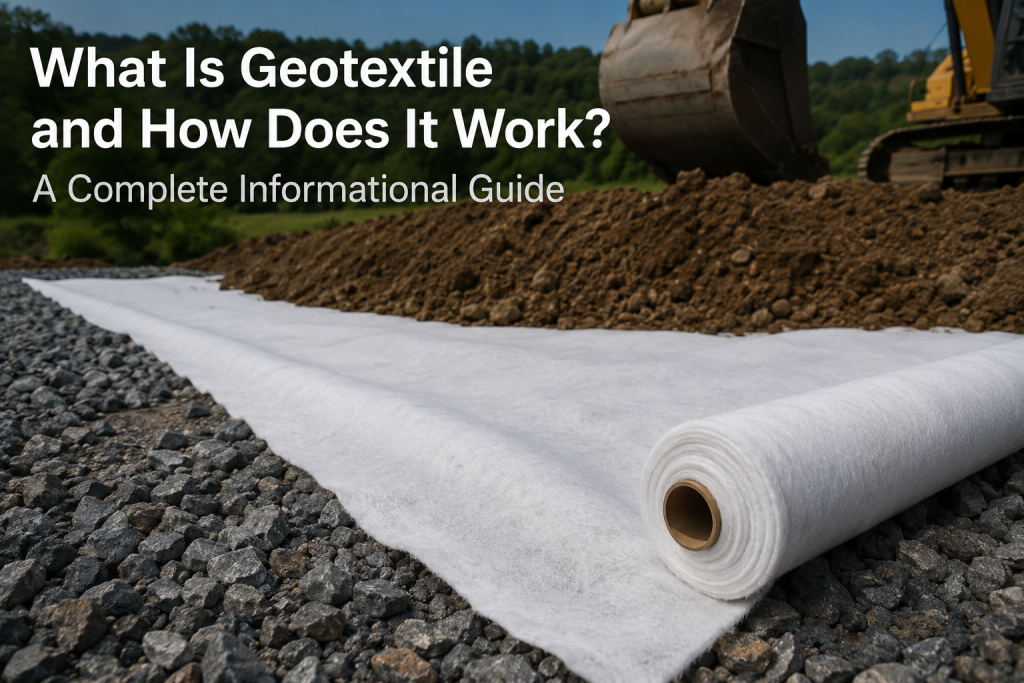
Geotextile is one of the most widely used materials in modern civil engineering, yet it remains largely invisible to the public. Buried beneath roads, embedded in embankments, laid under railway tracks and placed inside drainage trenches, geotextile fabric performs critical structural and hydraulic functions that keep infrastructure working correctly over its entire design life. This guide explains what geotextile is, how it is manufactured, what its primary functions are, and where it is most commonly applied.
Defining Geotextile: What It Is and What It Is Not
A geotextile is a permeable, synthetic textile material used in geotechnical and civil engineering applications. The word itself combines ‘geo’ (relating to the earth or ground) with ‘textile’ (a fabric structure). Geotextiles are manufactured exclusively from synthetic polymer fibres — most commonly polypropylene, polyester, or polyethylene — making them resistant to biological degradation, UV radiation and most chemicals encountered in soil environments.
It is important to distinguish geotextile from other geosynthetic materials. Geomembranes are impermeable barrier sheets. Geogrids are open-mesh reinforcing elements. Geocomposites combine multiple geosynthetic types in a single product. Geotextile, specifically, is a permeable fabric — water can pass through it, which is fundamental to its filtration and drainage functions.
Geotextiles are supplied in rolls, typically 4 to 6 metres wide and 50 to 200 metres in length, and are installed directly on or within a soil formation. They require no adhesives or fasteners and are joined using sewn seams or overlaps, depending on application requirements.
How Are Geotextiles Manufactured?
Woven Geotextiles
Woven geotextiles are produced on conventional looms by interlacing two sets of yarns — warp (longitudinal) and weft (transverse) — at right angles to one another. This produces a fabric with a clearly visible grid-like structure. Woven fabrics are characterised by high tensile strength in both principal directions and a relatively uniform, well-defined pore structure. The pore openings between yarns act as a controlled filter medium.
The tensile strength of woven geotextiles makes them particularly suitable for reinforcement and separation applications under high mechanical loading. However, their regular pore structure can be susceptible to blockage (clogging) in certain fine-grained soil environments where particle sizes closely match the pore openings.
Nonwoven Geotextiles
Nonwoven geotextiles are manufactured by bonding or entangling fibres into a continuous mat, without any weaving process. Two principal techniques are used: needle-punching (where barbed needles mechanically entangle the fibres) and heat-bonding (where fibres are fused at contact points by heat and pressure). The result is a thick, felt-like fabric with an irregular, tortuous pore structure.
The irregular pore network of nonwoven geotextiles provides superior filtration performance compared with woven fabrics in many soil types, because the tortuous flow path through the fabric prevents soil particles from passing straight through. Nonwovens also offer excellent conformability to irregular surfaces and high resistance to puncture, making them a versatile choice across a wide range of applications.
Knitted and Composite Geotextiles
Knitted geotextiles use an interlocking loop structure and are relatively uncommon in primary geotechnical applications. Composite geotextiles — combining a woven or nonwoven geotextile with a drainage core or geomembrane — are widely used in specialised drainage and protection applications, as discussed in other articles on this site.
The Five Primary Functions of Geotextile
The International Geosynthetics Society (IGS) defines five primary functions that geotextiles perform. Understanding these functions is essential to selecting and specifying the correct product for any application.
1. Separation
Geotextile placed between two dissimilar soil or aggregate layers prevents intermixing of those materials under load. A classic example is the placement of geotextile between a granular sub-base and a soft clay subgrade beneath a road pavement. Without separation, repeated traffic loading causes the subgrade clay to contaminate the granular layer (‘mud pumping’), reducing its load-spreading capacity and leading to rapid pavement deterioration. The geotextile maintains the integrity and engineering properties of both layers throughout the design life of the structure.
2. Filtration
A filtration geotextile allows water to flow freely through the fabric in the direction perpendicular to its plane, while retaining soil particles on its upstream face. This is the geotextile equivalent of a sand filter — it maintains hydraulic conductivity while preventing erosion of fine particles with the flowing water. Filtration geotextiles are used extensively in drainage trenches, behind retaining walls, around drainage pipes and in coastal protection works.
Correct filtration design requires careful matching of the geotextile’s Apparent Opening Size (AOS, also called O90 or O95 depending on standard) to the particle size distribution of the adjacent soil. This prevents both ‘piping’ (soil particles passing through the fabric) and ‘clogging’ (fine particles bridging and blocking the geotextile pores).
3. Drainage
Some geotextiles — particularly thick needle-punched nonwovens — are capable of transmitting significant water flows within the plane of the fabric itself (in-plane drainage). This transmissivity function is important in applications such as vertical drains in soft ground improvement, drainage layers beneath embankments, and geocomposite drainage blankets behind basement walls.
4. Reinforcement
Woven and high-tenacity knitted geotextiles can provide tensile reinforcement to soil structures. When a weak soil is loaded, it tends to spread laterally. A geotextile layer within the soil resists this lateral movement, improving the bearing capacity and stability of the overall system. Geotextile reinforcement is used in the basal layers of embankments over soft ground, in reinforced steep slope construction, and as reinforcement over potentially voided ground (such as in areas susceptible to sinkhole formation).
5. Protection
Geotextiles act as a protective cushion layer between geomembranes and angular subgrade materials or overlying aggregate layers. The geotextile absorbs stress concentrations that would otherwise cause puncture of the primary barrier membrane, extending the service life of the liner system significantly. This protection function is particularly important in landfill liner system design.
How to Select the Right Geotextile
Geotextile selection involves several key parameters that must be matched to both the soil conditions and the mechanical demands of the application:
Mass per unit area (g/m²): Higher mass generally indicates a thicker, more robust fabric with greater puncture resistance and in-plane transmissivity (for nonwovens).
Tensile strength (kN/m): The load-bearing capacity of the fabric in the machine and cross-machine directions. Critical for reinforcement applications.
Apparent Opening Size (AOS / O90 / O95): Defines the filtration characteristics. Must be matched to the particle size distribution of the retained soil.
Permittivity and transmissivity: Measures of how easily water flows through the fabric (normal to plane) and along the fabric (in-plane). Both must meet design requirements for drainage and filtration functions.
Burst strength and CBR puncture resistance: Governs survivability during installation, particularly when placed on rough subgrades or covered with angular aggregate.
UV resistance: Important if the geotextile will be exposed for extended periods during construction. Most polypropylene geotextiles are stabilised for limited UV exposure but should not be left uncovered for more than a few weeks.
Common Applications of Geotextile in Civil Engineering
Road construction: Geotextile separation layers beneath sub-base aggregate are among the most widespread geotextile applications globally, extending pavement life and reducing aggregate consumption.
Drainage trenches: Geotextile-wrapped aggregate drains (sometimes called French drains) are used for groundwater management in agriculture, highway shoulders, sports fields and building foundations.
Retaining walls: Geotextile filter layers behind retaining wall drainage systems prevent subgrade fine particles from migrating into the drainage layer and blocking the drainage path.
Coastal and riverbank protection: Geotextile underlayers beneath rock armour or concrete revetment prevent scour of underlying soil while maintaining drainage.
Landfill engineering: Protection layers, filtration layers within leachate collection systems, and cushion layers around drainage pipes all rely on geotextile products.
Landscaping and horticulture: Weed control fabrics, drainage layers in roof gardens and planting substrates in vertical garden systems all incorporate geotextile principles.
Summary
Geotextile is a deceptively simple product that performs complex and critical engineering functions. Whether separating dissimilar materials, filtering water while retaining soil particles, transmitting drainage flows, reinforcing weak ground or protecting primary geosynthetic barriers, geotextile fabrics are indispensable components of modern geotechnical and civil engineering practice. Understanding the distinction between woven and nonwoven products, and the five primary geotextile functions, is the foundation for correct product selection and specification in any application.